
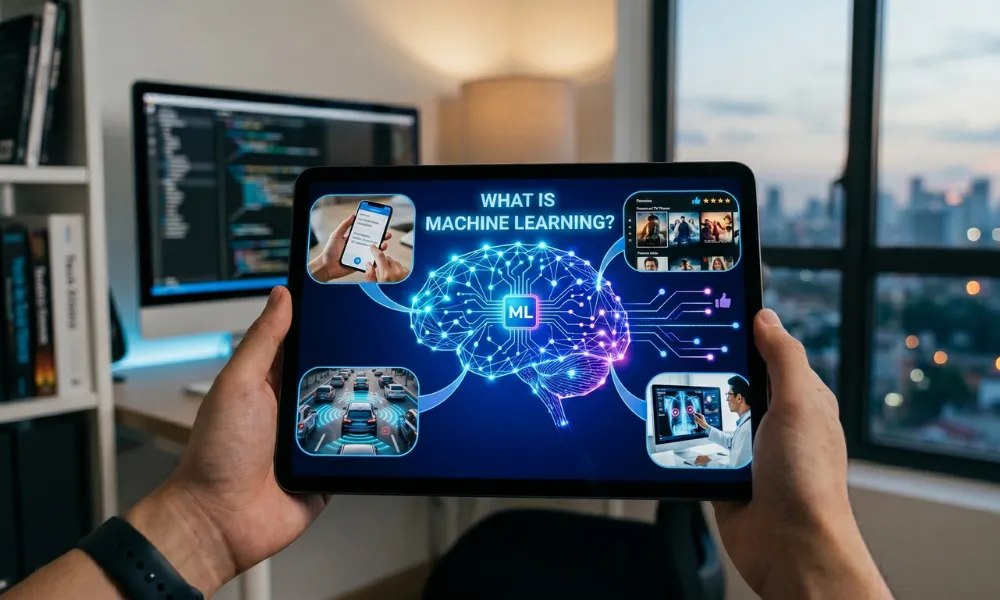
If you’ve ever asked Siri a question or gotten a Netflix show suggestion, you have already seen machine learning in action. But what is machine learning exactly? In simple words, machine learning (ML) is a part of artificial intelligence (AI) that teaches computers to learn from data. The computer is not given a step-by-step guide. Instead, it studies examples and finds patterns on its own.
Computer scientist Arthur Samuel first used the term in 1959. He described it as the ability of machines to learn without being told every single rule. Today, ML powers tools used in healthcare, finance, cybersecurity, and IT operations. It is one of the fastest-growing areas in tech. And it is changing how businesses work every day.
How is Machine Learning Different from AI and Deep Learning?
These three words get mixed up a lot. But they are not the same thing. Think of them like three circles, one inside the other. Here is a simple way to picture it before we go further into each one.
Artificial Intelligence
Artificial intelligence is the biggest circle. It covers any computer system that can do things humans normally do. Thinking, deciding, understanding language. All of that falls under AI. It can be simple rules or complex systems.
Machine Learning
Machine learning sits inside that big AI circle. It is a specific way to build AI. Instead of writing rules, you feed the computer data and let it learn. Banks use it to catch fraud. Doctors use it to read scans. It is everywhere.
Deep Learning
Deep learning is the smallest circle, sitting inside machine learning. It uses layers of connected math structures called neural networks. These work a bit like the human brain. Deep learning powers voice assistants and tools like ChatGPT.
Why Does Machine Learning Matter So Much?
A lot of technologies come and go. Machine learning is different. It is solving real problems that old methods simply could not handle.
It works with huge amounts of data. Every second, businesses collect millions of records. No human team can read all of that. ML algorithms go through it instantly and pull out what matters.
It keeps getting better on its own. Most software stays the same unless someone updates it. ML models improve every time they see new data. They do not need a programmer to step in.
It cuts down on costly mistakes. People get tired. People miss things. A well-trained machine learning model stays consistent. It applies the same logic every single time without getting distracted.
It helps businesses make better calls. Instead of guessing, companies can use predictive analytics to see what is likely to happen next. That means smarter spending, better planning, and faster growth.
How Does Machine Learning Actually Work?
It sounds complex. But the process is actually very logical. Think of it like teaching a child to recognize a dog.
The steps below build on each other, so reading them in order makes things much clearer.
Step 1: Collect the Data
You start by gathering examples. These could be emails, images, purchase records, or system logs. This is your raw material. Garbage data in means garbage results out. Quality matters here more than quantity.
Step 2: Clean the Data
Real data is messy. Some records are missing. Some have typos. Some are duplicates. Data preprocessing fixes all of that. It gets the data into a clean, usable shape before the model ever sees it.
Step 3: Train the Model
Now the algorithm digs in. It looks at the cleaned data over and over. Each time it makes a wrong guess, it adjusts. Each time it gets it right, it reinforces that pattern. This cycle is called model training.
Step 4: Test the Results
Before you trust the model with real decisions, you test it. You give it data it has never seen before. You check if the answers are right. Evaluation metrics like accuracy and precision tell you how well it is really performing.
Step 5: Put It to Work
Once the model passes testing, it goes live. Starts making real decisions. In IT environments, it can flag security threats, predict failures or sort tickets automatically. The work does not stop here. You have to keep watching it and updating it as the world changes.
The Four Types of Machine Learning
There are four types of machine learning. Each type solves a kind of problem. Each type of machine learning uses a method to learn. The method used depends on what your data looks like. You have to choose the type of machine learning based on your data.
Supervised Learning
This is the most common type. You give the model data that already has the right answers labeled. It learns to match inputs to outputs. Then it uses that knowledge on new, unseen data. Spam detection and credit scoring both use this approach.
Unsupervised Learning
Here, there are no labels. No right answers. The model explores the data on its own and finds natural groups and patterns. Retailers use it for customer segmentation. Security teams use it to spot unusual behavior on a network.
Semi-Supervised Learning
This one sits in the middle. You have a little labeled data and a lot of unlabeled data. The model uses the labeled part as a guide and fills in the gaps from the rest. It is a practical choice when labeling everything by hand would take too long.
Reinforcement Learning
This type learns like a person playing a video game. It tries something. If it works, it gets a reward. If it fails, it gets a penalty. Over many rounds, it figures out the best strategy. Robotics and autonomous systems use this heavily.
Where is Machine Learning Being Used Right Now?
You do not have to look far. Machine learning is already running in the background of tools you use every day.
Fraud Detection: Your bank does not have humans watching every transaction. ML does it. It spots patterns that look suspicious and blocks them before you even notice. JPMorgan alone processes billions of transactions this way every year.
Medical Imaging: Doctors at busy hospitals cannot manually review every scan. ML models trained on thousands of X-rays and MRIs now detect tumors and diseases with remarkable accuracy. Google’s Med-PaLM 2 already helps clinicians interpret complex medical data.
IT Predictive Maintenance: Instead of waiting for a server to crash, ML watches performance data constantly. It catches warning signs early. IT teams get ahead of problems before users ever feel the impact.
Smart Recommendations: Every time Netflix suggests a show or Amazon shows you a product you actually want, that is a recommendation engine powered by ML studying your habits quietly in the background.
Voice Assistants: Siri and Alexa use natural language processing to understand what you say, learn how you talk, and get better at helping you over time.
Machine Learning is Changing IT Operations
This is where things get really practical for IT teams. ML is not just a theory here. It is doing real work inside IT environments right now.
AIOps and AI Automation Services use ML to watch your entire IT environment around the clock. When something looks off, the system catches it fast and kicks off a fix automatically. Teams that used to drown in Level 1 tickets are now free to focus on work that actually matters.
Security is another area where ML changes everything. Cybersecurity Services powered by ML learn what normal network traffic looks like. The moment something breaks that pattern, an alert fires. No human could monitor that volume of data manually and respond as fast.
Managing cloud environments used to mean constant manual checks. Managed Cloud Operations now use ML to track usage, predict demand, and trim unnecessary costs. The system adapts without anyone needing to log in and tweak settings every day.
For teams still stuck doing repetitive IT tasks by hand, AI Workflow Automation Services bring ML into ticket routing, access provisioning, and escalation workflows. Less waiting. Fewer errors. Faster resolution.
The Future of Machine Learning
The next phase of machine learning is already here. Several key trends will shape how machine learning evolves in the coming years.
Multimodal AI is one trend. It will process text, images, audio and video together. In healthcare this means combining records with medical images. This helps doctors make diagnoses. In retail it means getting insights about customers from multiple data sources. Multimodal AI will help businesses understand their customers better.
Explainable AI (XAI) is becoming popular. As machine learning systems make important decisions, businesses need to know how and why a model made a decision. They need to trust the model. The global Explainable AI market is expected to reach $24.58 billion by 2030.
Federated Learning is another trend. It lets devices train models on their own without sharing data. This helps keep data safe. Federated Learning is a trend in machine learning.
Automated ML (AutoML) will allow teams without deep data science skills to build and deploy models. This democratizes ML across more industries and business sizes.
Conclusion
Machine learning is not something that is going to happen. It is something that is really working. It is changing the way companies do things. Machine learning is used for things like finding fraud and figuring out what is wrong with people who’re sick. Machine learning is also used to make computer systems work better.
For the people who work with computers, machine learning means they have to do work by hand, but they can fix problems faster and the computers are more reliable. If you know what machine learning is, then you can make decisions about the technology you use.
If you want to see how machine learning can help your company, you should look at the things that AI4IT Services is doing with machine learning and artificial intelligence.