

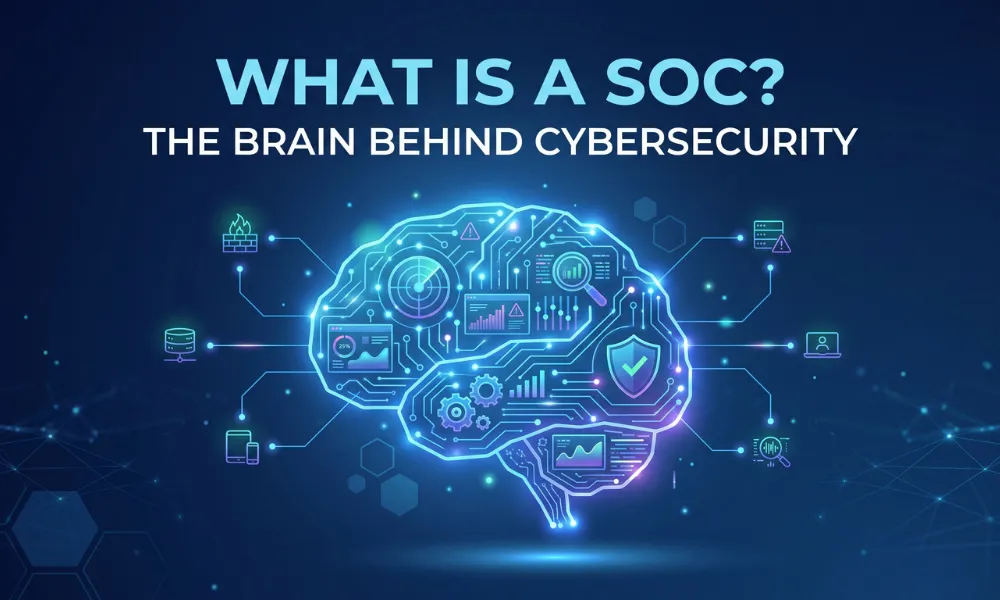
Cybercrime drained over $8 trillion from the global economy last year. Companies spent millions on firewalls and antivirus tools and still woke up to breach news about themselves. The tools were there. The protection was not.
A Security Operations Center (SOC) is a dedicated team that monitors, detects, and responds to cyber threats around the clock. It brings together skilled people, clear processes, and the right technology to protect what a business spent years building.
It is rarely about the technology failing. More often, it is about nobody being there to act on what the technology was already telling them. How that actually happens inside a working SOC is worth understanding properly.
Breaking Down the SOC: More Than a Room of Screens
Most people hear what a SOC is and picture tired analysts hunched over glowing screens in a dark room. That image does not come close to telling the real story. A SOC is where security analysts, threat hunters, and incident responders work together as an actual team rather than isolated people doing disconnected jobs.
Every endpoint, application, and network connection stays on their radar without a break. The second something feels wrong, the investigation starts right there and then. Nobody waits for a morning briefing or a weekly report.
The whole operation exists to catch problems while they are still containable, not show up after everything has already burned down.
Core Functions That Make a SOC Indispensable
A SOC carries real weight inside any security strategy that actually works. It watches infrastructure constantly to find weaknesses before attackers stumble across them. It also filters out the noise to surface threats that actually matter and handles incident response without burning through time nobody has to spare.
What businesses tend to miss is how tightly security and compliance live together in everyday operations. Pairing SOC work with a solid Compliance & Governance framework keeps GDPR, HIPAA, and other regulations covered without the last-minute scramble.
When audit season lands, organizations with an active SOC are not frantically piecing together records they should have been keeping all year. The documentation is already there, clean, organized, and ready to hand over.
The People Inside a SOC: Roles That Hold the Line
Security technology performs only as well as the people running it. Tier 1 analysts take the first wave of alerts, sorting real threats from background noise before anything has a chance to escalate.
Tier 2 analysts investigate incidents properly and coordinate containment while there is still a meaningful window to limit damage. Tier 3 specialists and dedicated threat hunters work proactively, tracking down threats that automated systems quietly walked past.
SOC managers hold the whole structure together by keeping workflows, team performance, and internal communication moving without friction. This layered setup serves a growing mid-sized business just as well as a large enterprise with far deeper pockets.
SOC Technologies Powering the Defense
Every tool inside a SOC earns its place for a specific reason. SIEM platforms gather log data from across the entire environment and surface patterns worth a closer look. EDR tools watch over individual devices and catch unusual behavior before it turns into something serious.
XDR stretches that visibility further across cloud systems, networks, and email at the same time. None of it holds together without reliable infrastructure underneath.
Pairing SOC capabilities with dependable Modern Networking Services closes the blind spots that attackers almost always target first. Strong security and strong infrastructure are genuinely the same conversation.
Types of SOCs: Finding the Right Fit
Not every organization builds its SOC the same way and that is perfectly fine. An internal SOC gives complete control and deep customization but demands serious upfront investment in people and infrastructure. A virtual SOC brings remote analysts in at a lower operational cost while keeping coverage solid.
A managed SOC hands daily security operations entirely to a specialized external team. For most growing businesses, the managed model is simply the most practical path forward. It delivers serious protection without spending years trying to build an internal team from the ground up.
Why a SOC Matters More in 2025 Than Ever
The threat environment today looks nothing like it did just five years ago. Ransomware groups now run like structured businesses, complete with negotiation teams and customer support lines. AI-assisted attacks probe networks faster than most traditional defenses can realistically track.
Without centralized monitoring, organizations take months on average just to notice a breach is happening, and by then, the damage has already moved quietly through the entire system.
Businesses pairing SOC capabilities alongside Managed IT Services respond to incidents faster and recover with noticeably less disruption than those operating without that combined foundation.
Building vs Buying
Standing up an internal SOC from scratch takes significant time, money, and patience that most businesses simply cannot afford.
Experienced security analysts are genuinely hard to find, salaries reflect that scarcity, and retaining cybersecurity talent remains one of the toughest challenges across the entire industry. Managed SOC providers cut straight through that problem.
Organizations gain trained analysts, enterprise-grade tools, and round-the-clock coverage without waiting years for an internal team to find its footing. For most businesses, thinking this through honestly, the managed or hybrid path delivers stronger protection at a cost that holds up over time.
FAQs
Is a SOC only relevant for large enterprises?
Managed SOC services have brought professional security within reach for businesses of every size. Smaller companies face the same threats large ones do and deserve the same level of protection.
What separates a SOC from an NOC?
A Network Operations Center keeps network performance stable and services running. A SOC focuses specifically on identifying threats, investigating incidents, and protecting sensitive data from harm.
How does a SOC respond to an active cyberattack?
The team isolates affected systems, eliminates the root cause, and restores normal operations as quickly as the situation allows. Every action follows a structured response plan built for exactly these moments.
Does a SOC eliminate the risk of breaches?
Nothing removes risk completely, and any provider claiming otherwise is not being straight. A SOC significantly cuts response time and limits how much damage actually reaches critical systems.
What does it cost to set up a SOC?
An internal SOC runs into millions annually once staffing, tooling, and infrastructure costs stack up together. Managed SOC services offer predictable subscription pricing that fits within a realistic and sustainable business budget.