

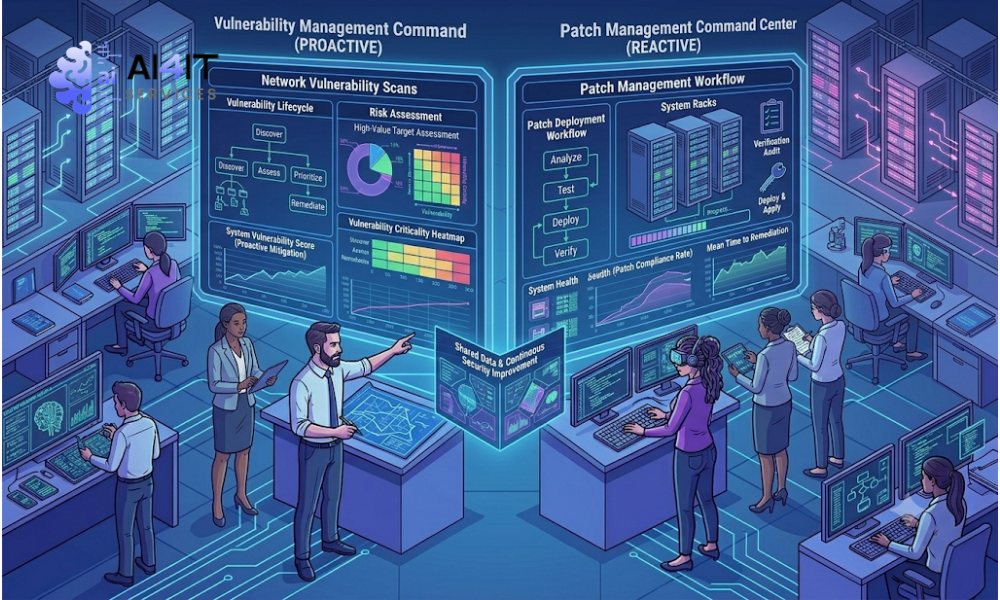
Do you install patches for known and/or easily discovered security holes? There are numerous IT groups that feel that Vulnerability Management and Patch Management are two distinct activities. One will see what’s wrong and the other will fix it.
Now the question is, what will you do if you discover a vulnerability in your system, but you don’t have any patches?
The Two Sides of Cybersecurity Risk Mitigation Strategies
Vulnerability Management is an iterative process of scanning all your IT assets using Security Vulnerability Scanning tools and then identifying and prioritizing all of your vulnerabilities. The focus of Patch Management is Software patching – vendor-supplied patches to rectify known vulnerabilities.
They’re both necessary and useful, and they have distinct functions. Vulnerability management provides you with the answer to where you’re vulnerable. Patch Management will let you know what is being patched.
Only known vulnerabilities are available in the form of patches. On the other hand, segmentation, behavior monitoring, and access restrictions are the things that are needed to protect against zero-day vulnerabilities. Know how to conduct the Cloud Security Audits for AI4IT.
The way the IT Asset Vulnerability Assessment works
A thorough IT asset vulnerability assessment isn’t limited to your network devices and cloud workloads, nor just to third-party software, or endpoints on your network, and it doesn’t just return a list of what you found; it returns a prioritised list of your IT risks. There is no emphasis on critical exposure, and teams spend time talking about other issues that are not critical.
The presence of a formal enterprise cybersecurity management program, and the fact that an organization has a remediation program that incorporates scanning, improves the chances of driving remediation in an organization.
The Security Patch Deployment Lifecycle Has More Steps Than Most Teams Realize
Test Before You Deploy
Do not deploy patches in the production environment. A staging environment can help you make sure that the fix doesn’t negatively affect any existing functionality.
Prioritize by Risk, Not Release Date
A CVSS 9.8 patch with critical severity is more critical than a CVSS medium severity patch NOT being published to the public. The basis for your queue needs to be risk scoring.
Validate After Deployment
Check to see that the patch did not cause new issues and that it was successful. This is one thing that is least done, and that’s where organizations burn the most.
AI4IT’s Managed Cloud Operations optimizes this lifecycle flexibly on the AWS, Azure, and GCP data centers, all with AI.
Zero-Day Vulnerability Protection Requires More Than Patches
One kind of vulnerability has no patch to solve it until exploited (known as a zero-day vulnerability). Only detection and limiting access to “just what is needed” and monitoring (not scanning!) can be effective in providing protection.
Another key component of the Security Awareness Training from AI4IT is the scenarios to reduce the likelihood of identity attacks at the human layer, which is the first layer of the Zero Day attack.
Creating a Framework that connects both
The most resilient organisations have no vulnerability or patch management programs. They enable a common language environment to be created for the scanning feeds, which can then be used immediately in patch prioritization, and the unpatched risks are connected to compensating controls when the patch is available.
There is a time period between the discovery of the problem and successful resolution – AIOps and IT Automation Services for AI can help reduce this time.
Which One Should You solve first?
Solving the issues that pose the greatest business impact that are most likely to be taken advantage of. But if the critical vulnerability is released first, that’s not important – a critical vulnerability on an internet-facing system is more important than a medium vulnerability on an isolated system.
Responsibility matters too, and these functions being handled by a different group of people and not being handed over from security to IT mean that vulnerabilities are detected but not addressed. The AI4IT Cybersecurity Services team helps to facilitate the linking of both services under a single risk scenario of “vulnerability discovery” equaling “vulnerability remediation” and making it a conversation.