
Is your organisation truly empowered with the use of AI tools across all teams? Most leaders concur that yes, staff could be using unauthorized AI without the knowledge of the IT department. This can be a significant security problem and invisible technical debt.
The next big question is, how long are you willing to just go without?
What Is Shadow AI and Why Is It Growing Fast?
Shadow AI is one particular category of IT shadow involving generative and/or machine learning platforms that ingest, store, and distribute sensitive business information.
These are simple and easy to use by employees. In some industries, the number of instances of using shadow AI has increased significantly over the past year, according to the new figures, and is now far beyond the scope of IT’s visibility.
This unchecked usage can lead to “hidden” parallel systems developing within your businesses, of which compliance teams have no knowledge, when they undertake work through the power of AI.
A Dangerous Evolution between Shadow IT and Shadow AI?
For many years, shadow IT has been a problem for IT teams. Totally the same, but with Shadow AI. For instance, if the employees are providing the customer data to the publicly available AI model to create the summary, or providing the proprietary source code to the publicly available AI model, there may be GDPR, HIPAA, or SOC 2 requirements that apply, and the employee might not know, for instance.
But there are some risks associated with AI governance and compliance that may attract regulatory fines and loss of trust from customers. If an organisation has an existing audit program, it is now clear that any connection to their cloud infrastructure without authorization is yet another avenue to the threat surface, and that cloud security audits are a vital security practice for organisations to undertake.
The ways that Technical Debt can appear in the context of Shadow AI
Every time someone in the company has used an unmanaged AI tool in a business process, there’s a technical debt in the AI system. It is only possible to do that when:
- The code that is written by the AI is not checked for security.
- Departments develop workflows that can be acquired instantly.
- Data can be shared with third parties for use in the training of their models.
- Future audits become much more complicated, since the legacy becomes enmeshed with unmanaged layers of AI.
It is difficult to identify these machine learning operational risks, and even more difficult to mitigate them. The solution is to have complete visibility of all data flows and to proactively manage your cloud operations.
The Risk Areas Every IT Leader Must Know
Data Security and Leakage
Your DLP and CASB are not designed to cover the activities of Shadow AI tools. Regular HTTPS traffic contains sensitive data that is not a part of the current security infrastructure and poses very serious enterprise data security issues.
Compliance Exposure
If your employees are using unapproved software to process patient information or the financial records, you may find yourself in a potentially serious HIPAA or GDPR, SOC 2 compliance situation, and not even know you are in trouble.
Widened Attack Surface
Unmanaged third-party integrations are examples of unmanaged tools. Researchers have already shown that AI-model files can contain malicious payloads – vulnerabilities in AI-based systems which are not part of your monitoring system.
Operational Inconsistency
Without the proper governance and tools, teams can inherit tools that haven’t been vetted and rely on the output of those tools, which is not predictable, and as time goes on, affects the quality of business decisions.
Enterprise AI Risk Management Strategies That Work
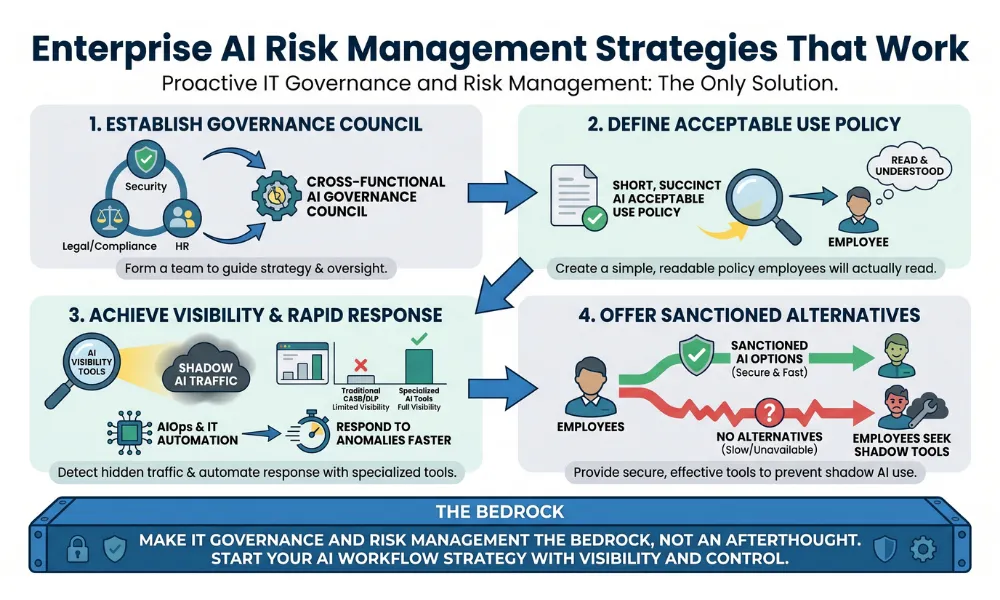
The only solution is to take proactive steps in IT governance and risk management. Establish a cross-functional AI governance council, including security, legal/compliance, and HR. Then make a short, succinct AI acceptable use policy, one that will actually be read by employees.
Purchase AI visibility tools, as traditional CASB and DLP products will not be able to see the shadow AI traffic. Combined with AIOps and IT automation services, you can better respond to anomalies in less time. Most especially, offer sanctioned AI alternatives when there are sanctioned options that are slow or not available, employees will seek out shadow tools.
Make IT governance and risk management the bedrock and not an afterthought, and start your AI workflow strategy with visibility and control.
The Long-Term Cost of Doing Nothing
The unaddressed shadow AI compounds. Gartner predicts that by 2027, 75% of employees will acquire or create technology outside IT’s visibility. Centralized security models will not scale to meet that reality.
Digital transformation security risks can start out as a noncompliance matter and progress to data breaches and regulatory scrutiny. The first step is to comprehend the complete network where you function; shadow AI dangers can be delivered by means of the same network that your business uses daily.
The potential hazards of generative AI within the workplace are very real and increasing. Even if you don’t know it, shadow AI is probably already occurring in your organisation! Whether you have a plan to deal with it or it will deal with you is the only question.