

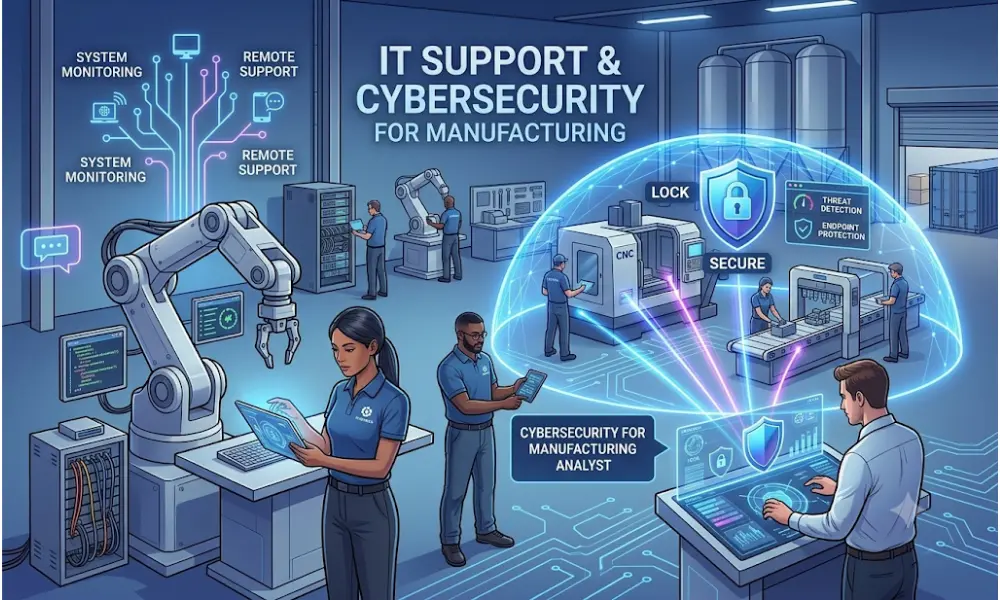
Hackers are targeting factories more than most people realize, and production lines pay the price in downtime and lost trust. A single breach can freeze operations for days and cost thousands per hour in missed output.
That’s exactly why plants running on connected machines can’t skip IT Support and Cybersecurity for Manufacturing Companies anymore.
IBM’s Cost of a Data Breach Report has flagged manufacturing among the top three targeted industries for years running.
This isn’t a maybe anymore, it’s a pattern showing up in breach reports every single year. So, what actually keeps a factory floor protected when threats never clock out?
The Manufacturing Threat Landscape Is Changing
Plants used to sit isolated from the outside world, disconnected from broader networks and safer for it. Not anymore. IoT sensors and connected equipment opened doors nobody planned for, and hackers found them fast.
Old PLCs running next to shiny new cloud platforms create gaps that go unnoticed until something breaks down. This is where IT Support and Cybersecurity for Manufacturing Companies earns its keep, patching the mismatch between legacy hardware and modern software stacks.
One weak vendor in the supply chain can drag an entire network down with it. Industrial cybersecurity risks are multiplying faster than most internal teams can track alone. Attackers know factories often skip updates, and that assumption keeps paying off for them repeatedly.
Why Downtime Costs More Than Money
A stalled production line means missed shipments and clients who quietly start looking elsewhere for suppliers. Factories can’t just send everyone home during an outage since machines still need running safely.
Solid IT Support and Cybersecurity for Manufacturing Companies protects more than files sitting on a server somewhere. It protects the entire operation’s ability to function normally day to day.
Penalty clauses, strained vendor calls, and damaged reputation all stack up fast after a malware hit.
Disaster recovery planning matters just as much as any firewall when uptime defines the whole business model. Recovery speed often decides whether a client relationship survives an incident or quietly ends.
Building a Strong Cybersecurity Foundation
Good protection starts with actually knowing what’s connected to the network in the first place. Firewalls, endpoint protection, and segmented networks together shrink the attack surface considerably over time.
Plenty of manufacturers now lean on AI Automation in IT Operations since it catches strange behavior faster than a dashboard being watched manually. Training staff still matters too, and that part often gets overlooked entirely.
Phishing remains the easiest way in, and one alert line supervisor can stop what a firewall might miss. Regular drills and simple reminders tend to work better than long compliance manuals nobody reads.
The Role of Managed Services in Daily Operations
Hiring a full security team internally isn’t realistic for most mid-sized manufacturing plants today. That’s where Managed IT Services come in, taking over routine patching and monitoring around the clock.
Internal staff get to focus on actually running production instead of chasing alerts. It tends to cost less too, while still offering coverage that never really clocks out.
Threats don’t wait for nine to five, so protection shouldn’t either. Round the clock monitoring also means smaller issues get caught before they turn into major outages.
Practical Steps Manufacturers Can Take Today
A handful of consistent habits make a bigger difference than most people expect. Keep operational technology networks separate from everyday corporate IT systems.
Patch software on a fixed schedule instead of waiting for trouble. Back up critical data offsite and actually test the recovery process. Limit system access so only the right people reach sensitive areas.
Skip even one of these steps, and it’s usually the one an attacker finds first. Consistency, more than complexity, tends to separate secure plants from vulnerable ones.
Choosing the Right Support Partner
Price shouldn’t be the only factor when picking who handles factory IT needs. Providers who actually understand shop floor equipment and ERP systems catch risks generalists often miss completely.
AI4IT Services work this way, blending automation with real hands on support for manufacturing clients. Instead of leaving plants guessing when something goes sideways, the focus stays on quiet reliability.
Nothing flashy, just systems that keep running steadily in the background every day. Talking to a specialized IT partner now often uncovers gaps sitting unnoticed for months already.