

AI-Powered Cyberattacks in 2026: How U.S.A. Businesses Can Protect Themselves
Category: Cybersecurity / IT Security
Reading time: 8-10 minutes
Target audience: U.S.A. business owners, IT managers, system administrators, cybersecurity professionals, and decision-makers
Artificial intelligence is transforming how American businesses operate, but it is also changing how cybercriminals conduct attacks. In 2026, attackers can use AI tools to create convincing phishing messages, impersonate executives, automate reconnaissance, analyze exposed systems, and scale existing cybercrime techniques.
For U.S.A. companies, the challenge extends beyond traditional viruses and suspicious emails. Organizations must protect employee identities, cloud environments, business applications, corporate networks, and sensitive customer information against increasingly automated threats.
Businesses of every size can be affected. A small company with limited IT resources may face risks from business email compromise, ransomware, or stolen credentials, while larger enterprises must manage complex cloud infrastructure, supply-chain exposure, and regulatory obligations.
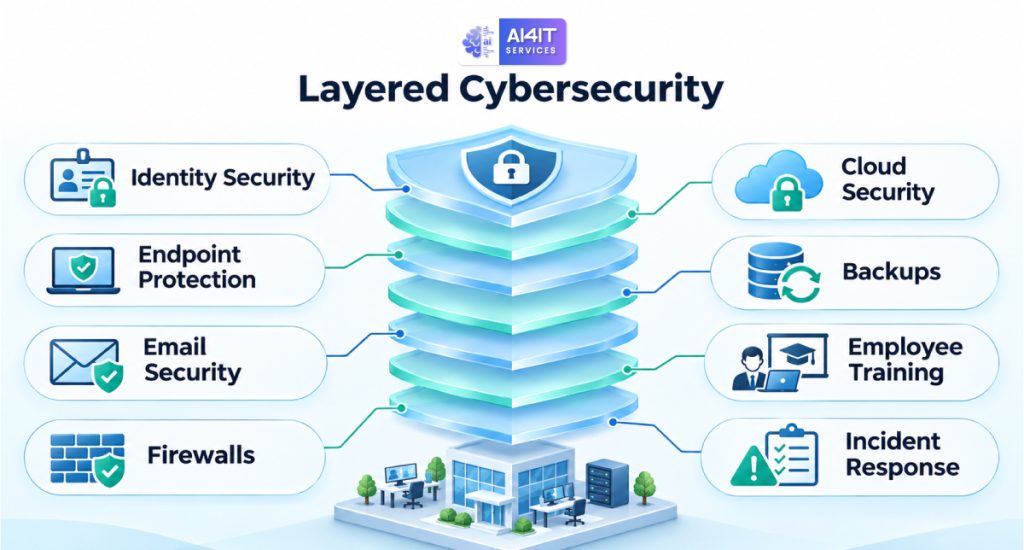
The solution is not simply to purchase another security product. Organizations need a layered cybersecurity strategy that combines technical controls, employee awareness, access management, incident response, and continuous monitoring.
At AI4IT Services, businesses can explore IT-related resources and discuss their technology requirements. This guide explains the major AI-powered cyber threats affecting U.S.A. businesses, how organizations can reduce their exposure, and what to do if an attack occurs.
What Are AI-Powered Cyberattacks?
AI-powered cyberattacks are cyberattacks in which criminals use artificial intelligence to assist, automate, or improve activities such as social engineering, reconnaissance, impersonation, vulnerability analysis, or malware development.
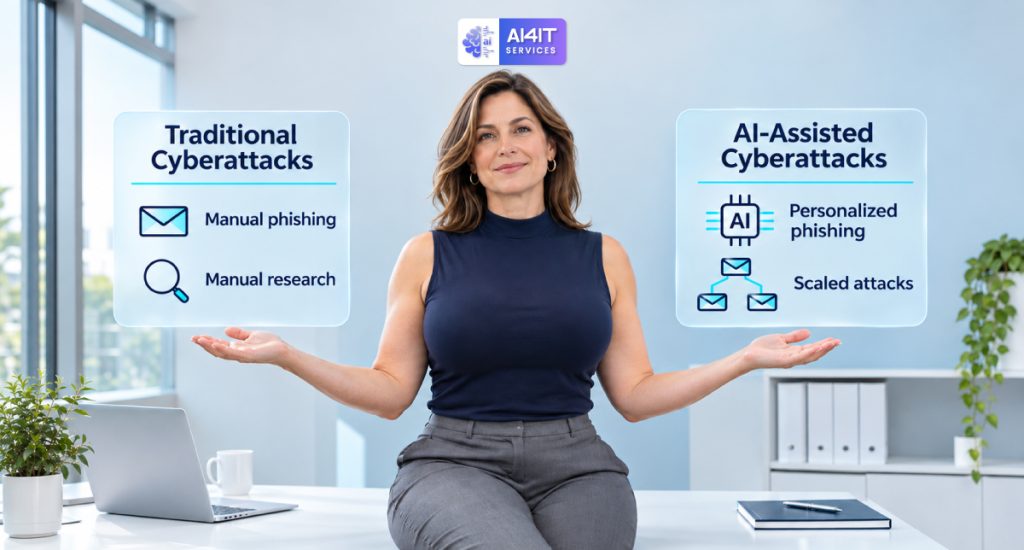
AI does not necessarily create an entirely new category of attack. In many cases, it helps attackers perform familiar techniques faster, personalize messages, or conduct attacks at greater scale.
For example, an attacker might use AI to generate an email that imitates a company’s CEO, create synthetic audio resembling a finance director, or analyze publicly exposed systems for potential weaknesses.
AI agents can also introduce risks when connected systems have excessive permissions or exposed credentials. An attacker who compromises an inadequately secured AI workflow may be able to misuse its authorized access.
For U.S.A. businesses, understanding these threats is important because an attack can affect customer data, business operations, financial transactions, contractual obligations, and regulatory compliance.
Why AI-Powered Cyberattacks Matter to U.S.A. Businesses in 2026
American businesses depend on email, cloud services, remote access, online payments, customer databases, and connected applications. These systems create opportunities for attackers when identities, software, or configurations are not adequately protected.
AI can make some attacks more convincing and easier to scale. However, conventional weaknesses such as stolen credentials, unpatched software, excessive permissions, and misconfigured cloud resources remain important risks.
U.S.A. organizations should pay particular attention to the following developments:
- AI-generated phishing: Attackers can produce polished, personalized messages that imitate employees, executives, vendors, and service providers.
- Deepfake impersonation: Synthetic voices and video can be used to make fraudulent requests appear legitimate.
- Automated reconnaissance: Attackers can use automation to examine exposed systems and identify potential weaknesses.
- Credential theft: Compromised passwords, session tokens, and privileged accounts can provide access to business systems.
- Ransomware and data theft: Criminals may attempt to disrupt operations, steal information, or demand payment.
- AI application vulnerabilities: Poorly secured AI assistants and agents may expose data or misuse connected tools.
Businesses should not assume every sophisticated attack uses AI. Traditional phishing, weak authentication, vulnerable software, and inadequate backups remain major security concerns.
U.S.A. Cybersecurity Resources Every Business Should Know
American organizations can use established federal cybersecurity resources to develop and improve their security programs.
- Cybersecurity and Infrastructure Security Agency (CISA) – cybersecurity guidance, alerts, and resources for organizations.
- FBI Internet Crime Complaint Center (IC3) – a reporting channel for suspected internet-related crimes.
- National Institute of Standards and Technology (NIST) – cybersecurity frameworks, standards, and guidance.
- Federal Trade Commission (FTC) – business guidance on data security and privacy.
- CISA Secure Our World – practical security guidance covering passwords, multifactor authentication, software updates, and phishing.
For businesses reviewing their IT environment, AI4IT Services is a starting point for discussing technology requirements and potential areas for further assessment.
7 Major Types of AI-Powered Cyberattacks Targeting U.S.A. Companies
1. AI-Generated Phishing Emails
Phishing is a common method for stealing credentials, delivering malicious attachments, or persuading employees to visit fraudulent websites.
AI can help criminals produce professional-looking messages tailored to a particular employee, company, industry, or business relationship.
For example, an employee might receive an email that appears to come from a Microsoft 365 administrator, payroll provider, bank, or company executive. The message may request a password reset, urgent payment, or access to a shared document.
Warning signs include:
- Unexpected requests for passwords or authentication codes.
- Unusual payment instructions.
- Urgent requests that bypass normal approval procedures.
- Links leading to unfamiliar domains.
- Unexpected attachments or QR codes.
- Requests to move a business conversation to an unusual communication channel.
How U.S.A. businesses can protect themselves:
- Use phishing-resistant multifactor authentication where practical.
- Deploy email filtering and domain authentication controls.
- Train employees to verify sensitive requests through a separate channel.
- Establish documented procedures for supplier payments and account changes.
- Make it easy for employees to report suspicious messages.
- Review email forwarding rules and unusual sign-in activity.
Spelling mistakes are no longer a reliable way to identify phishing. AI-generated messages may look professional and use accurate business terminology.
For additional guidance, visit CISA Secure Our World.
2. Deepfake Voice and Video Scams
AI-generated audio and video can be used to impersonate executives, employees, customers, and business partners.
For example, a finance employee might receive a call that appears to feature the CEO requesting an urgent wire transfer. A video meeting could also be used to create a false sense of trust.
These attacks may target companies of any size, particularly when employees can initiate payments or change vendor banking information without independent verification.
Recommended protections:
- Require independent verification for financial transfers.
- Use established approval workflows for sensitive transactions.
- Confirm unusual requests using a known telephone number or trusted internal channel.
- Do not treat a voice or video call as sufficient proof of identity.
- Train finance, payroll, and HR teams to recognize impersonation attempts.
- Separate payment initiation from payment approval.
Key rule: Never approve a sensitive financial transaction solely because a request appears to come from a familiar person.
3. AI-Assisted Malware and Ransomware
Attackers may use AI to assist with reconnaissance, script development, or the adaptation of existing malicious tools.
Ransomware can disrupt a business by encrypting systems, stealing information, or threatening to publish confidential data. The impact can include operational downtime, recovery expenses, lost revenue, and damage to customer trust.
AI assistance may increase the speed or scale of certain attack activities, but successful intrusion still depends on factors such as access, vulnerabilities, and security controls.
Business protection measures:
- Keep operating systems, applications, and firmware updated.
- Use appropriate endpoint detection and response (EDR) protection.
- Restrict administrative privileges.
- Segment networks to limit unauthorized movement between systems.
- Maintain isolated or immutable backups where suitable.
- Test data restoration and disaster recovery procedures.
- Establish and rehearse an incident response plan.
- Monitor suspicious file activity and unusual system behavior.
Backups should be protected from the same compromised administrator accounts that control production systems.
Businesses assessing their server, hosting, or infrastructure requirements can visit AI4IT Services to discuss their IT needs.
4. Automated Vulnerability Discovery and Exploitation
AI-assisted tools can help attackers analyze software, investigate exposed services, and identify potential weaknesses. Combined with automated scanning and exploitation tools, these capabilities may shorten the time available for businesses to identify and fix vulnerabilities.
Common areas of concern include:
- Publicly exposed administrative interfaces.
- Unpatched web applications and server software.
- Weak API authentication.
- Overly permissive cloud roles.
- Exposed credentials and API keys.
- Insecure remote-access services.
- Outdated third-party software.
Recommended protections:
- Maintain an accurate inventory of internet-facing assets.
- Patch known vulnerabilities according to risk and exposure.
- Remove unnecessary public access to administrative interfaces.
- Secure APIs with appropriate authentication and authorization.
- Scan applications and infrastructure for known weaknesses.
- Rotate exposed credentials and revoke unused keys.
- Review cloud permissions regularly.
- Monitor important configuration changes.
Organizations can use the CISA Known Exploited Vulnerabilities Catalog to help prioritize vulnerabilities known to be exploited in the wild. Federal agencies have specific requirements associated with this catalog; private companies should use it as a risk-prioritization resource appropriate to their environment.
5. Credential Theft and Account Takeover
Credentials are valuable targets because legitimate accounts can provide access to email, cloud infrastructure, business applications, and sensitive records.
AI may assist with personalized phishing and automated attack workflows, but the underlying problem often remains compromised or misused identities.
How to reduce the risk:
- Require multifactor authentication for critical accounts.
- Prefer phishing-resistant authentication, such as passkeys or hardware security keys, where supported.
- Use a password manager and unique passwords.
- Disable inactive accounts promptly.
- Limit administrator accounts and privileges.
- Monitor unusual sign-ins, sessions, and privilege changes.
- Revoke sessions and rotate credentials after suspected compromise.
- Review service accounts, API keys, and automation credentials.
AI agents also require secure identities. Non-human accounts can become powerful attack paths if they have excessive permissions.
6. Business Email Compromise and Payment Fraud
Business email compromise (BEC) occurs when attackers impersonate or compromise business communications to trick employees into transferring money, sharing confidential information, or changing payment details.
AI can help criminals produce messages that reflect a company’s terminology, suppliers, projects, and communication style.
Recommended protections:
- Verify bank-account changes with a known supplier contact.
- Require independent approval for high-value payments.
- Separate payment creation from payment authorization.
- Monitor suspicious email forwarding rules.
- Protect email accounts with strong authentication.
- Establish a documented process for urgent financial requests.
- Train accounts payable and finance employees to recognize fraudulent instructions.
Technical email controls are important, but financial verification procedures are equally necessary.
7. Attacks Against AI Applications and Autonomous Agents
U.S.A. companies increasingly use AI assistants, copilots, workflow automation, and autonomous agents. These systems may connect to email, document repositories, customer databases, cloud infrastructure, and internal APIs.
If an AI system has excessive permissions, an exposed credential, or inadequate safeguards, an attacker may exploit that access to retrieve information or initiate unauthorized actions.
Potential risks include:
- Sensitive information disclosed through AI tools.
- Prompt injection through untrusted documents or web content.
- Misuse of connected applications and APIs.
- Excessive permissions granted to autonomous agents.
- Exposure of API keys and credentials.
- Inadequate logging of AI-driven actions.
How businesses can protect AI systems:
- Assign each agent a dedicated identity.
- Apply least-privilege permissions.
- Separate read-only access from write or administrative actions.
- Require approval for high-impact operations.
- Restrict which tools and APIs an agent can use.
- Treat external documents and retrieved content as untrusted input.
- Log agent actions and monitor unusual behavior.
- Test failure scenarios before enabling production access.
Businesses deploying AI agents should also review the NIST AI Risk Management Framework and relevant guidance for securing AI systems.

Warning Signs U.S.A. Businesses Should Monitor
Early detection can help organizations contain suspicious activity before it causes significant damage.
IT and security teams should monitor for:
- Repeated failed login attempts or unusual authentication patterns.
- Sign-ins from unfamiliar devices or unexpected locations.
- New administrator accounts or unexpected privilege changes.
- Unusual access to sensitive files or cloud storage.
- Unexpected changes to email forwarding rules.
- New API keys or credentials that were not approved.
- Large or unusual data transfers.
- Unexpected modifications to security configurations.
- New services or processes running on critical servers.
- AI agents performing actions outside their assigned tasks.
No single signal proves that an attack is occurring. Security teams should investigate events in context, correlate related alerts, and follow an established incident response process.
How U.S.A. Businesses Can Protect Themselves From AI-Powered Cyberattacks
A practical cybersecurity strategy combines preventive controls, monitoring, employee awareness, and incident response.
1. Strengthen Identity and Access Security
Identity security should be a priority because attackers often target credentials to gain legitimate-looking access.
Implement multifactor authentication, strong password practices, least-privilege access, privileged account controls, and regular access reviews.
Pay particular attention to administrator accounts, remote access, cloud consoles, service accounts, and AI agents.
2. Keep Software and Infrastructure Updated
Unpatched operating systems, web applications, plugins, network devices, and server software can expose organizations to known vulnerabilities.
Maintain an asset inventory, apply security updates according to risk, remove unsupported software, and verify that internet-facing systems are appropriately protected.
For server and web-hosting environments, review administrative access, security configurations, backups, and exposed services as part of routine maintenance.
3. Deploy Layered Security Monitoring
Firewalls, endpoint security, email protection, logging, and centralized monitoring provide different types of visibility.
Depending on organizational needs, businesses may consider EDR, managed detection and response (MDR), or security information and event management (SIEM) solutions.
Monitoring should cover important systems, including identity providers, cloud environments, servers, endpoints, and business-critical applications.
4. Protect Business Data and Backups
Identify sensitive information and restrict access according to business requirements.
Use appropriate encryption, data-loss prevention controls, retention policies, and secure backup practices. Test restoration procedures regularly so the organization can recover from ransomware, accidental deletion, or other incidents.
5. Train Employees to Recognize AI-Assisted Scams
Security awareness training should cover realistic scenarios rather than relying only on generic warnings.
Employees should learn how to verify urgent requests, recognize suspicious links, report unusual login prompts, validate payment changes, and respond to possible deepfake impersonation.
Conduct approved phishing simulations where appropriate and use the results to improve training.
6. Establish an Incident Response Plan
Businesses should know what to do when an account is compromised, malware is detected, sensitive information is exposed, or a critical system becomes unavailable.
An incident response plan should define:
- Who investigates and makes decisions.
- How compromised accounts and devices are isolated.
- How credentials and access tokens are revoked.
- How evidence is preserved.
- How systems are restored.
- Who communicates with employees, customers, and relevant authorities.
- When external cybersecurity support is required.
Review the plan periodically and test it through tabletop exercises or controlled simulations.
7. Secure Cloud Environments and Remote Access
Cloud infrastructure introduces security responsibilities involving identity, permissions, network configuration, application security, and data protection.
Use secure administrative access, restrict public exposure, review storage permissions, monitor cloud activity, and protect secrets and API credentials.
Remote access should use strong authentication and appropriate access controls. Avoid exposing remote management interfaces directly to the internet without suitable safeguards.
8. Review AI Tools Before Introducing Them Into Business Workflows
Employees may use AI applications for writing, coding, data analysis, or customer support. Organizations should understand how these services handle submitted data, store information, manage access, and connect to other systems.
Create a clear policy describing what employees may share with approved AI tools. Evaluate vendor security and privacy practices, and limit integrations to those that are necessary.
For autonomous agents, use explicit action permissions, approval requirements, and activity logs.
U.S.A. Business Cybersecurity Checklist for 2026
Use this checklist to identify areas that may need attention.
- Multifactor authentication is enabled for critical accounts.
- Administrator access is restricted and regularly reviewed.
- Operating systems and applications receive timely security updates.
- Internet-facing assets are inventoried and monitored.
- Email security and domain authentication controls are configured.
- Employees know how to report suspicious messages and calls.
- Cloud storage and API permissions are reviewed regularly.
- Backups are protected and restoration has been tested.
- Security logs and critical alerts are monitored.
- Incident response procedures are documented and tested.
- AI tools have clear data-handling policies.
- AI agents have limited permissions and auditable actions.
- Suppliers and third-party service providers are assessed for relevant security risks.
- Applicable U.S.A. state and federal privacy or industry requirements have been identified.
Businesses do not need to implement every advanced technology immediately. Start with the controls that address the most important risks in your environment, then improve coverage over time.
For help discussing your organization’s IT requirements, visit AI4IT Services or book an appointment.
U.S.A. Cybersecurity Regulations and Reporting Considerations
Cybersecurity and data-protection obligations depend on the company’s industry, location, size, customers, and the information it handles.
Businesses should consider whether any of the following apply to their operations:
- State data-breach notification laws: Requirements vary by state and may depend on the type of information involved.
- FTC requirements: Certain businesses may be subject to the FTC Act or specific rules, including the Safeguards Rule for covered financial institutions.
- HIPAA: Certain healthcare organizations and business associates must follow applicable requirements for protected health information.
- GLBA: Covered financial institutions have obligations related to safeguarding customer information.
- SEC cybersecurity disclosure requirements: Certain public companies have cybersecurity disclosure and reporting obligations.
- Contractual and industry requirements: Customer contracts, cyber-insurance policies, and industry-specific standards may impose additional security duties.
Not every regulation applies to every company. Businesses should confirm their obligations with qualified legal and compliance professionals.
Where Should U.S.A. Businesses Report Cybercrime?
The appropriate reporting channel depends on the incident.
- FBI Internet Crime Complaint Center (IC3) – report suspected internet-related crime, including online fraud and business email compromise.
- CISA – access guidance for reporting cybersecurity incidents and suspicious activity.
- Local FBI field office – contact the FBI for relevant criminal matters.
- Appropriate state authorities, regulators, law enforcement, or sector-specific agencies may also need to be notified.
Organizations should preserve evidence, follow their incident response plan, and determine which reporting deadlines and obligations apply. Do not delay urgent containment while trying to determine whether an incident involved AI.
What Should a U.S.A. Business Do If It Suspects an AI-Powered Cyberattack?
The response should focus on containing the incident, preserving evidence, and restoring systems safely. Do not assume an attack is AI-powered simply because the message or activity appears sophisticated.
Recommended initial steps include:
- Activate the incident response process. Notify the designated IT or security team.
- Contain affected systems. Isolate compromised devices or accounts when appropriate, considering business and safety impacts.
- Protect identities. Revoke compromised sessions, disable affected credentials where necessary, and reset credentials using a trusted process.
- Preserve evidence. Retain relevant logs, messages, timestamps, and system details.
- Assess the scope. Determine which accounts, devices, applications, and data may have been affected.
- Remove the cause. Address the exploited vulnerability, exposed credential, malicious configuration, or other entry point.
- Restore and validate. Recover systems from trusted sources and confirm that security controls are functioning.
- Follow reporting requirements. Contact appropriate authorities and comply with applicable contractual and regulatory obligations.
Avoid immediately wiping every affected device if doing so would destroy important forensic evidence. Coordinate containment and recovery with qualified incident responders.
Businesses can consult CISA’s cybersecurity resources and FBI IC3 for official guidance and reporting options.
The Role of AI in Cybersecurity Defense
AI can also help defenders process security information and investigate incidents. When properly integrated and supervised, AI-assisted security tools may help teams:
- Summarize alerts and investigate related events.
- Identify unusual patterns in logs and endpoint activity.
- Prioritize potential vulnerabilities.
- Enrich incidents with contextual information.
- Assist with phishing analysis.
- Draft incident reports and remediation plans.
- Automate well-defined response procedures.
However, AI-generated findings should be validated, especially when they lead to disruptive actions. AI is not a substitute for accurate telemetry, secure architecture, tested controls, and skilled security personnel.
Businesses should evaluate AI security tools according to their integration capabilities, data-handling practices, detection quality, false-positive rates, access permissions, and operating costs.
For organizations reviewing their broader IT environment, AI4IT Services provides a starting point for discussing technology requirements.
Frequently Asked Questions
What are AI-powered cyberattacks?
AI-powered cyberattacks are attacks in which artificial intelligence assists with activities such as phishing, impersonation, reconnaissance, vulnerability analysis, or automation. Many still rely on familiar weaknesses, including stolen credentials and unpatched software.
Are AI-powered cyberattacks a major concern for U.S.A. businesses in 2026?
Yes. AI can help attackers scale some techniques and automate parts of their workflows. However, the level of risk varies by organization, and traditional security weaknesses remain significant.
Can AI create convincing phishing emails?
AI tools can generate polished and personalized phishing messages. Employees should verify unexpected requests, inspect links carefully, and follow established procedures for sensitive actions.
How can U.S.A. businesses protect themselves from deepfake scams?
Use independent identity verification, require multiple approvals for sensitive transactions, and confirm unusual requests through a trusted communication channel. Do not rely on voice or video alone.
Can AI agents attack business systems?
AI agents can be misused to automate reconnaissance or other attack activities. Agents also create risks when they have excessive permissions or access to exposed credentials. Organizations should apply least privilege, restrict tools, monitor activity, and require approval for high-impact actions.
What is the first step in protecting a U.S.A. business against AI cyber threats?
Start by strengthening identity security, patching exposed systems, reviewing administrator privileges, protecting backups, and ensuring employees can report suspicious activity.
Should small U.S.A. businesses invest in advanced cybersecurity tools?
Small businesses should begin with essential controls such as strong authentication, software updates, secure backups, endpoint protection, and email security. Additional monitoring or managed security services may be appropriate depending on the organization’s risk, resources, and technical expertise.
Are U.S.A. businesses legally required to report cyberattacks?
Reporting obligations depend on the type of organization, the incident, the data involved, and applicable state and federal laws or contracts. Businesses should consult qualified legal and compliance professionals to determine the requirements that apply to them.
How often should businesses review their cybersecurity?
Critical controls should be monitored continuously where practical. Access permissions, vulnerabilities, backups, and incident response plans should be reviewed on a risk-based schedule, with additional reviews following significant infrastructure changes or security incidents.
Conclusion
AI-powered cyberattacks are changing the speed, scale, and sophistication of some cybersecurity threats in 2026. Attackers can use AI to assist phishing, impersonation, reconnaissance, and other activities, while compromised identities, exposed credentials, and misconfigured systems remain common points of weakness.
U.S.A. businesses can reduce their exposure by strengthening identity security, updating software, protecting cloud infrastructure, training employees, securing AI integrations, monitoring critical systems, and testing incident response plans.
Organizations should also understand their applicable U.S.A. regulatory obligations and know where to report suspected cybercrime.
The most effective strategy is not to rely on a single security product. It is to build a layered defense that combines technology, sound processes, employee awareness, and continuous improvement.
Discuss Your IT Requirements With AI4IT Services
Businesses reviewing their cybersecurity posture should begin by identifying their most important systems, understanding their risks, and prioritizing practical security improvements.
Visit AI4IT Services to learn more about the company and its IT-related resources.
Ready to discuss your technology requirements?
Book an appointment with AI4IT Services to discuss your IT infrastructure and potential next steps.
Protecting your business starts with understanding your risks and taking consistent, measurable action.