

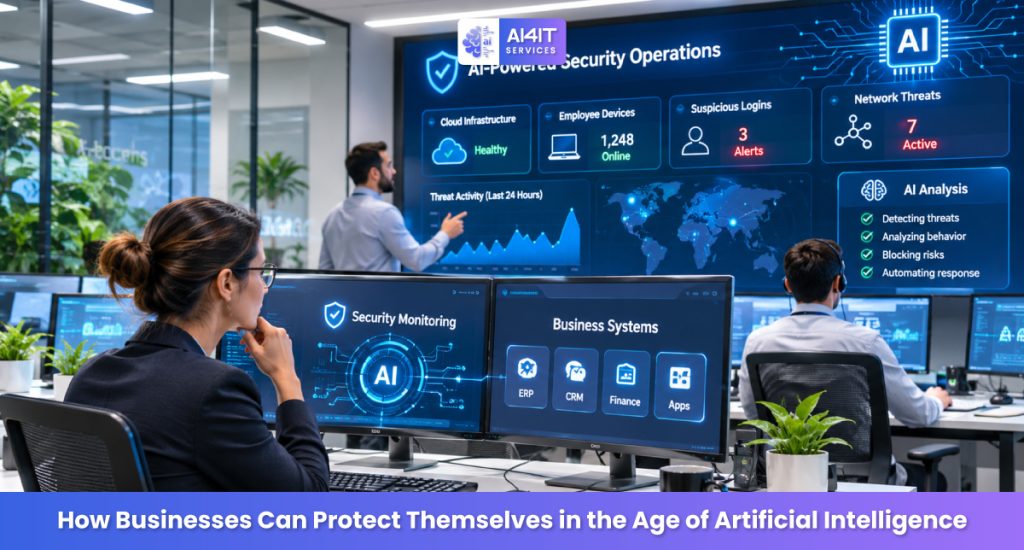
Artificial intelligence is changing how businesses operate. Employees are using AI assistants to create documents, analyze information, automate tasks, and communicate with customers. IT teams are using AI to monitor infrastructure, troubleshoot problems, and improve productivity.
But there is another side to this change.
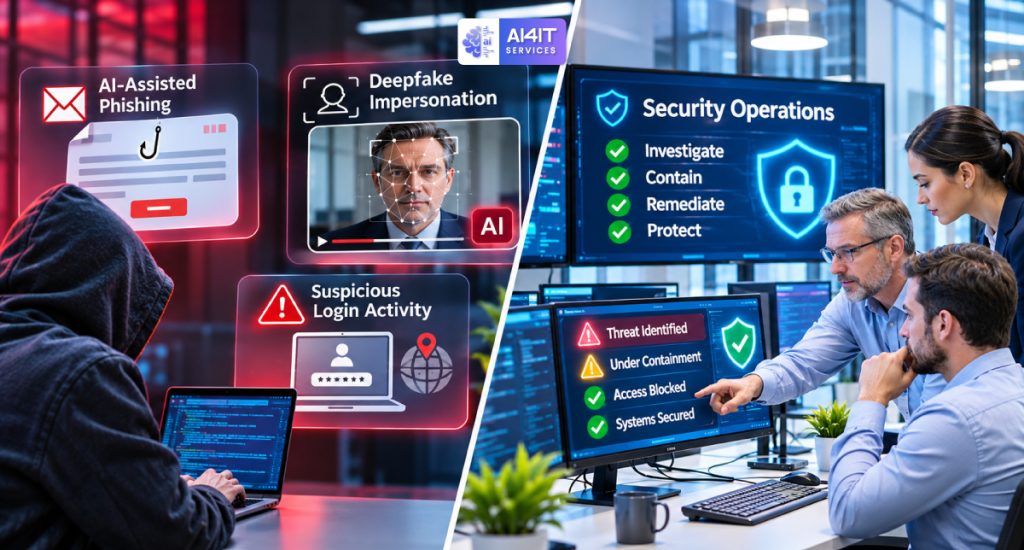
Cybercriminals are also using AI to create more convincing phishing emails, automate parts of their attacks, impersonate people, and search for weaknesses in business systems.
For small and mid-sized businesses, this creates a new challenge: How do you protect your business when both cybersecurity threats and the tools used to defend against them are becoming more intelligent?
Traditional security measures such as firewalls, antivirus software, passwords, and backups are still important. However, businesses increasingly need additional capabilities to identify suspicious behavior, detect threats earlier, protect cloud applications, and respond to incidents more efficiently.
This is where AI-powered cybersecurity solutions can help.
In this guide, we explore how AI is changing cybersecurity, which AI security solutions businesses should consider, how AI can work alongside Zero Trust, and how U.S. small and mid-sized businesses can build a stronger security strategy in 2026.
What’s Your Cybersecurity Risk Score?
Before investing in new cybersecurity technology, understand how well your business is currently protected.
Do you have strong account security? Are your devices monitored? Can your business identify suspicious activity? Are your backups protected?
Take a moment to assess your organization’s cybersecurity posture.
Check Your Cybersecurity Risk Score
Identify potential security gaps and understand where your organization may need stronger protection.
Why Cybersecurity Is Changing in the AI Era
Cybersecurity has always involved a race between attackers and defenders. What is changing is the speed and scale at which both sides can operate.
Businesses now face threats involving:
- AI-generated phishing messages.
- Deepfake voice and video impersonation.
- Automated password and credential attacks.
- Faster reconnaissance of exposed systems.
- Malicious files and suspicious scripts.
- Attacks targeting cloud accounts and business applications.
- Attempts to manipulate AI assistants and automated agents.
- Data exposure through poorly configured AI tools.
A convincing email from someone claiming to be the CEO may be difficult to recognize. A fake voice message requesting an urgent payment may sound realistic. An employee might also accidentally upload confidential company information into an AI application without understanding its data-handling policies.
These risks are not limited to large enterprises. Small businesses can also be targets because they often have fewer dedicated security resources.
The challenge is no longer just protecting computers from malware. It is protecting identities, business data, applications, cloud environments, employees, and the AI systems themselves.
How Are Cybercriminals Using AI?
Understanding how attackers use AI helps businesses decide where stronger security controls are needed.
1. AI-generated phishing attacks
Traditional phishing emails often contain spelling mistakes, suspicious formatting, or unnatural language.
AI tools can help attackers create messages that sound more professional and match the communication style of a business, supplier, or colleague.
These messages may imitate:
- Company executives.
- Finance departments.
- IT support teams.
- Customers and suppliers.
- Banks and payment providers.
An employee may receive what appears to be a normal request to review an invoice, reset an account, or approve a payment.
What businesses should do: Use advanced email security, MFA, domain protection, employee awareness training, and additional approval procedures for financial transactions.
2. Deepfake voice and video scams
AI-generated audio and video can be used to impersonate real people.
For example, an employee might receive a call that appears to come from a senior manager requesting an urgent bank transfer.
The voice may sound familiar, but that does not prove the request is genuine.
What businesses should do: Establish independent verification procedures for payments, account changes, and sensitive instructions. Use known contact numbers and approved approval workflows instead of relying on a voice or video call alone.
3. Automated cyber reconnaissance
Attackers can use automation and AI-assisted tools to analyze publicly available information and identify potential weaknesses.
These activities may involve looking for exposed services, outdated software, misconfigured cloud resources, and vulnerable applications.
What businesses should do: Maintain an accurate asset inventory, patch known vulnerabilities, monitor internet-facing systems, and conduct regular security assessments.
4. Credential theft and account compromise
Stolen passwords remain a serious security risk.
Attackers may use automated tools to test stolen credentials against business applications or attempt to exploit weak authentication practices.
What businesses should do: Enforce MFA, block known compromised credentials where supported, restrict login attempts, and monitor unusual sign-in activity.
5. AI-assisted malware and social engineering
AI can help attackers produce convincing messages, analyze information, and automate parts of their workflows. It may also help them adapt attacks to particular organizations.
However, AI does not automatically make every attack more sophisticated or successful. Traditional malware, stolen credentials, and poorly secured systems remain major sources of risk.
What businesses should do: Maintain endpoint protection, application controls, security monitoring, reliable backups, and a tested incident response plan.
What Are AI-Powered Cybersecurity Solutions?
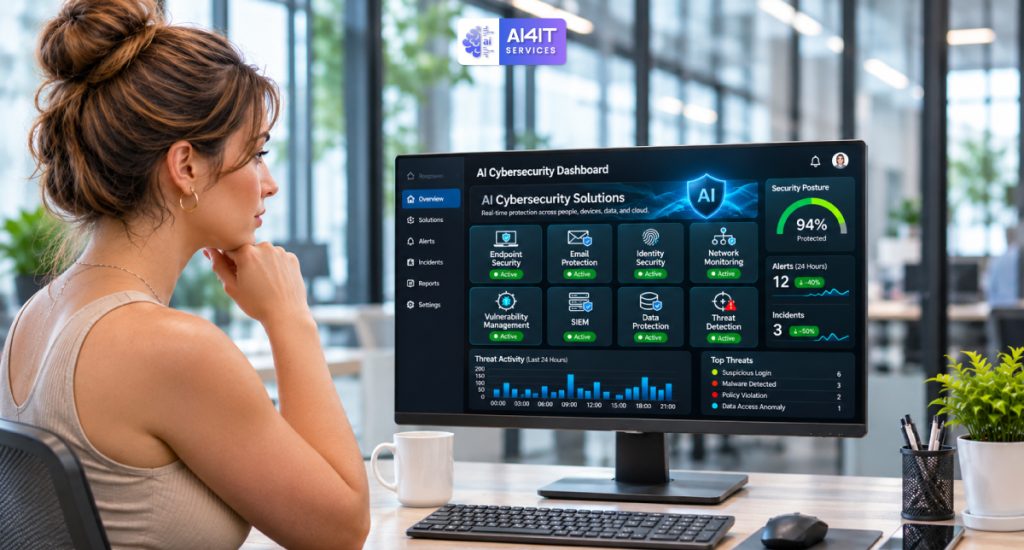
AI-powered cybersecurity solutions use machine learning, behavioral analysis, automation, and other intelligent techniques to help security teams identify and respond to suspicious activity.
Traditional security tools often depend heavily on predefined rules, signatures, and known threat indicators.
AI-enhanced tools can also analyze patterns and identify behavior that may be unusual for a particular user, device, or environment.
For example:
A finance employee normally accesses accounting software during business hours from a managed company laptop. Suddenly, the same account attempts to download a large volume of financial records from an unfamiliar device.
An AI-enhanced security system may recognize that this activity differs from the account’s normal behavior and generate an alert for investigation.
Depending on the platform and configuration, the system may recommend additional verification, restrict access, or trigger an approved response workflow.
AI does not need to make every security decision independently. In many business environments, its most useful role is helping security teams identify important signals faster and prioritize their work.
8 AI Cybersecurity Solutions Businesses Should Consider
AI cybersecurity is not one product. It is a collection of technologies that protect different parts of the business.
Here are eight areas worth considering.
1. AI-powered threat detection and response
Security teams receive alerts from computers, servers, applications, networks, and cloud services.
It can be difficult to investigate every alert manually, especially for a small IT department.
AI-assisted detection tools can analyze security events, identify unusual patterns, correlate related alerts, and help prioritize potentially serious incidents.
Examples of relevant technology include:
- Extended Detection and Response (XDR).
- Endpoint Detection and Response (EDR).
- Security analytics.
- Behavioral threat detection.
Business benefit: Helps identify suspicious activity and reduce the time required to investigate security alerts.
2. AI-powered endpoint security
Employee laptops and desktops are common entry points for cyberattacks.
Modern endpoint protection platforms can combine malware detection, behavioral analysis, attack prevention, and investigation capabilities.
Depending on the product, they may help identify:
- Suspicious processes.
- Unexpected file changes.
- Unusual application behavior.
- Potential ransomware activity.
- Unauthorized access attempts.
- Malicious scripts and execution patterns.
Business benefit: Provides additional protection for company devices and helps security teams investigate endpoint incidents.
3. AI email and phishing protection
Email remains one of the most common ways attackers attempt to reach employees.
AI-enhanced email security can analyze message characteristics, sender behavior, links, attachments, and other signals to identify potentially harmful messages.
Useful capabilities include:
- Phishing detection.
- Malicious link analysis.
- Attachment scanning.
- Impersonation protection.
- Suspicious sender detection.
- Business email compromise alerts.
Business benefit: Helps reduce the likelihood of employees interacting with malicious messages.
4. AI identity and access protection
Compromised accounts can provide attackers with access to email, cloud applications, business records, and internal systems.
AI-assisted identity security can identify unusual sign-in patterns, suspicious access behavior, and potentially compromised accounts.
Combine these capabilities with:
- Multi-factor authentication.
- Conditional access.
- Privileged access management.
- Least-privilege permissions.
- Automated account-risk alerts.
Business benefit: Helps detect suspicious account activity and strengthen protection around employee identities.
5. AI network security monitoring
Businesses need visibility into communication between computers, servers, cloud environments, and external services.
AI-assisted network monitoring can help identify unusual traffic patterns, unexpected connections, and suspicious communication behavior.
Depending on the environment, this may involve:
- Network Detection and Response (NDR).
- Intrusion Detection Systems (IDS).
- Intrusion Prevention Systems (IPS).
- Firewall analytics.
- Network anomaly detection.
Business benefit: Helps identify suspicious network activity that may not be obvious through basic firewall monitoring.
6. AI vulnerability management
Every business has systems that require regular updates and maintenance.
AI-assisted vulnerability management can help security teams prioritize weaknesses by considering available vulnerability information, asset importance, exposure, and other risk indicators.
It can support:
- Vulnerability discovery.
- Asset prioritization.
- Patch recommendations.
- Configuration reviews.
- Exposure analysis.
- Remediation tracking.
Business benefit: Helps businesses focus on the weaknesses that deserve attention first instead of treating every vulnerability as equally urgent.
7. AI security monitoring and incident response
Security Information and Event Management (SIEM) platforms collect and analyze information from different systems.
AI-assisted security operations capabilities can help summarize alerts, correlate events, support investigations, and recommend response actions.
Some platforms also support approved automation, such as disabling a compromised account or isolating an affected device.
These actions should be carefully controlled. High-impact actions should have appropriate approval and rollback procedures.
Business benefit: Helps IT teams investigate incidents more efficiently and coordinate responses.
8. AI data protection and insider-risk monitoring
Businesses store valuable information in cloud drives, email systems, databases, and internal applications.
AI-assisted data protection tools can help identify unusual data access, risky sharing behavior, and potential exposure of sensitive information.
Relevant capabilities include:
- Data Loss Prevention (DLP).
- Data classification.
- Insider-risk detection.
- Sensitive data discovery.
- Cloud data access monitoring.
- Unusual download alerts.
Business benefit: Helps organizations understand how sensitive information is being accessed and shared.
AI vs. Traditional Cybersecurity: What’s the Difference?
AI does not make traditional cybersecurity obsolete. The strongest security programs combine established security controls with intelligent detection and automation.
| Security activity | Traditional approach | AI-enhanced approach |
| Malware detection | Known signatures and rules | Behavioral and pattern-based analysis alongside signatures |
| Email security | Spam filters and predefined rules | Contextual analysis and suspicious behavior detection |
| Login protection | Password and MFA checks | Additional analysis of sign-in patterns and risk signals |
| Network monitoring | Rules and known indicators | Anomaly detection and event correlation |
| Vulnerability management | Manual reviews and scheduled scans | Risk-based prioritization and automated analysis |
| Incident investigation | Manual log review | AI-assisted correlation and investigation summaries |
| Data protection | Static access policies | Additional analysis of unusual access and sharing behavior |
| Response | Technician-led actions | Approved automated workflows with human oversight |
The actual capabilities depend on the product and configuration. A traditional tool can be highly effective, while an AI-enabled product can still produce inaccurate alerts or miss threats.
The goal is to use AI where it provides measurable value.
How AI Works with Zero Trust Security
AI-powered cybersecurity and Zero Trust work particularly well together.
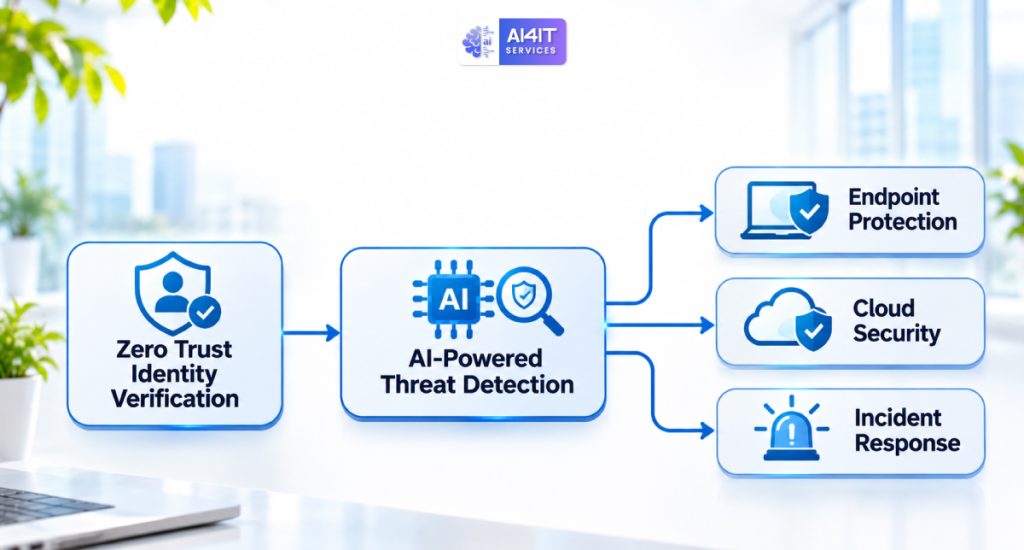
Zero Trust focuses on verifying every access request and limiting permissions. AI can help identify suspicious behavior and provide additional information when access decisions need to be reviewed.
Consider this example:
An employee signs in to the company’s cloud platform using valid credentials.
The identity system verifies the user and checks the device. The access policy allows entry to the employee’s approved applications.
Later, the account begins accessing unusual files and downloading information at an unexpected rate.
An AI-assisted monitoring system identifies the unusual activity and generates an alert. Depending on the configured policies, the organization may require additional verification, suspend access, or escalate the incident for investigation.
The combination provides several layers of protection:
- Identity verification confirms who is requesting access.
- Device security evaluates the device’s condition.
- Least privilege limits available resources.
- AI-assisted monitoring identifies unusual behavior.
- Security automation helps coordinate an appropriate response.
- Human oversight ensures important decisions are reviewed.
Zero Trust controls access. AI helps identify suspicious activity and supports security operations. Together, they create a stronger security approach.

How to Protect Your Business from AI-Related Security Risks
Businesses also need to secure the AI tools they use internally.
An organization may deploy AI assistants, automated workflows, customer support chatbots, document analysis tools, and AI agents.
These systems can introduce new risks if they have access to sensitive information or can perform actions without appropriate controls.
Important risks include:
1. Sensitive information exposure
Employees may enter customer records, financial information, passwords, internal documents, or confidential business details into AI tools without understanding how the information is handled.
Protection: Establish approved AI usage policies, review provider data-handling terms, restrict access to sensitive information, and train employees on safe usage.
2. Prompt injection
A malicious instruction hidden in a document, webpage, email, or other input may attempt to manipulate an AI assistant into ignoring its intended instructions or taking an unauthorized action.
Protection: Treat external content as untrusted, restrict tool permissions, validate outputs, and require approval for sensitive actions.
3. Excessive AI agent permissions
An AI agent connected to email, cloud storage, databases, or business applications may be able to perform actions beyond what it actually needs.
Protection: Give agents narrowly scoped permissions, limit their access to specific resources, and monitor the actions they perform.
4. Data poisoning and manipulated information
AI systems can produce unreliable results if the data they use is inaccurate, manipulated, or poorly controlled.
Protection: Review data sources, restrict who can modify important datasets, maintain audit trails, and test AI systems regularly.
5. Third-party AI service risks
An AI application may depend on external APIs, models, cloud services, and data processors.
Protection: Assess vendors, review security documentation, understand data retention practices, and establish contractual requirements.
6. Uncontrolled automated actions
An AI system may make an incorrect recommendation or take an action that disrupts business operations.
Protection: Use human approval for high-impact actions, establish clear operating limits, maintain logs, and provide a way to stop or reverse automated actions.
In May 2026, CISA and partner agencies published guidance on the careful adoption of agentic AI services. It highlights risks such as excessive privileges, unexpected behavior, and accountability gaps, and recommends limiting agent autonomy, applying layered defenses, and maintaining continuous monitoring.

A Practical AI Cybersecurity Strategy for Small and Mid-Sized Businesses
You do not need to build a large security operations center to start improving your cybersecurity.
The best approach is to combine essential security controls with AI capabilities that address your actual business risks.
Here is a practical implementation roadmap.
Step 1: Assess your current cybersecurity risks
Identify your most important systems, including:
- Employee laptops and desktops.
- Business email accounts.
- Cloud applications.
- Company servers.
- Customer databases.
- Websites and web applications.
- Remote access systems.
- Backup infrastructure.
Identify where sensitive information is stored and who can access it.
Step 2: Strengthen identity security
Enable MFA for employees, administrators, and external service providers.
Review access permissions, remove unused accounts, and protect privileged identities.
Step 3: Protect endpoints and servers
Deploy suitable endpoint security, keep operating systems updated, and monitor devices for suspicious activity.
Make sure servers and internet-facing systems receive regular security maintenance.
Step 4: Improve email and phishing protection
Use email authentication and protection technologies, configure domain protections such as SPF, DKIM, and DMARC, and train employees to recognize impersonation attempts.
Establish independent verification for sensitive financial requests.
Step 5: Introduce AI-assisted security monitoring
Evaluate whether AI-enhanced EDR, XDR, SIEM, or managed security services can help your team identify suspicious activity and investigate incidents.
Choose capabilities based on your existing environment rather than purchasing overlapping products.
Step 6: Secure cloud applications and sensitive data
Review cloud permissions, external sharing, data retention, and access to business information.
Restrict AI application access to approved data and systems.
Step 7: Protect your AI applications
Create an internal AI usage policy. Review third-party AI tools, restrict agent permissions, and test systems for unsafe behavior before allowing them to perform important business tasks.
Step 8: Prepare for incidents
Maintain protected backups, document response procedures, and test recovery.
Define who is responsible for investigating suspicious activity and approving security actions.
AI Cybersecurity Tools and Platforms Businesses Can Explore
The right technology depends on your existing systems, business size, security requirements, and budget.
Here are examples of established platforms and security product categories worth evaluating.
| Security area | Example platforms | What to evaluate |
| Endpoint security | Microsoft Defender for Business, CrowdStrike Falcon | Malware prevention, endpoint detection, response |
| Email protection | Microsoft Defender for Office 365, Proofpoint | Phishing, impersonation, malicious attachments |
| Identity protection | Microsoft Entra ID, Okta | MFA, conditional access, identity risk |
| Security monitoring | Microsoft Sentinel, Splunk | Event correlation, investigation, automation |
| Network protection | Fortinet, Palo Alto Networks | Firewall security, traffic inspection, threat detection |
| Cloud security | Microsoft Defender for Cloud, relevant cloud-native security tools | Cloud configuration, workload protection, exposure |
| Vulnerability management | Tenable, Qualys | Asset discovery, vulnerability assessment, remediation |
| Data protection | Microsoft Purview and other DLP platforms | Data classification, sharing controls, sensitive information protection |
These products have different capabilities and licensing requirements. Not every feature is AI-powered, and product capabilities change over time. Businesses should verify current features, integration requirements, and total costs before purchasing.
For many SMBs, a well-configured combination of identity protection, endpoint security, email security, backups, and managed monitoring is a better starting point than buying multiple overlapping platforms.
Can AI Replace a Human Cybersecurity Team?
No. AI can support cybersecurity professionals, but it should not replace human responsibility.
AI tools can help identify suspicious activity, summarize alerts, prioritize vulnerabilities, and automate approved tasks.
However, people are still needed to:
- Investigate complex incidents.
- Verify whether alerts are genuine.
- Make business-critical decisions.
- Approve sensitive actions.
- Manage security policies.
- Assess vendor risks.
- Communicate during incidents.
- Validate AI-generated recommendations.
An AI system can produce an incorrect result or miss an important threat. Businesses should establish human oversight, particularly when automated actions could affect financial systems, customer data, production infrastructure, or employee accounts.
The most effective approach is to let AI reduce repetitive security work while people remain accountable for important decisions.
How Much Does AI Cybersecurity Cost for an SMB?
There is no single price for AI cybersecurity.
Costs depend on the number of users and devices, existing subscriptions, cloud infrastructure, security requirements, monitoring coverage, and the level of managed support required.
A small business may already have access to useful security capabilities through its existing Microsoft or Google subscriptions.
A larger organization may need dedicated endpoint protection, centralized monitoring, cloud security, vulnerability management, or a managed detection and response service.
Consider these investment priorities:
| Priority | Security investment | Business purpose |
| High | MFA and identity protection | Reduce account compromise risk |
| High | Endpoint protection | Protect employee devices and servers |
| High | Email security | Reduce phishing and impersonation risks |
| High | Secure backups | Support recovery from incidents |
| Medium | Vulnerability management | Identify and prioritize weaknesses |
| Medium | AI-assisted security monitoring | Improve threat investigation |
| Medium | Cloud security monitoring | Identify cloud exposure and misconfigurations |
| Advanced | Managed detection and response | Provide ongoing monitoring and incident support |
| Advanced | AI security testing and governance | Protect AI applications and automated agents |
The objective should be to improve protection in measurable ways, not simply to purchase the largest number of security products.
How to Measure the Effectiveness of AI Cybersecurity
Once AI security tools are deployed, businesses need to understand whether they are making a meaningful difference.
Track metrics such as:
| Metric | What it tells you |
| Mean time to detect (MTTD) | How long it takes to identify suspicious activity |
| Mean time to respond (MTTR) | How long it takes to respond to a security incident |
| Phishing detection rate | How effectively suspicious messages are identified |
| Endpoint coverage | Percentage of business devices protected by endpoint security |
| MFA coverage | Percentage of accounts protected by MFA |
| Vulnerability remediation time | How quickly important security weaknesses are fixed |
| False-positive rate | How often legitimate activity is incorrectly flagged |
| Incident recurrence | Whether previously identified problems keep happening |
| Backup recovery success | Whether important data can be restored successfully |
A good security program should improve detection and response without overwhelming employees or IT teams with unnecessary alerts.
What NIST and CISA Recommend for AI Cybersecurity
U.S. organizations do not need to develop an AI security strategy entirely on their own. Government agencies and cybersecurity organizations are publishing guidance to help businesses understand the opportunities and risks.
NIST: Cyber AI Profile
NIST is developing its Cyber AI Profile to help organizations address three important areas:
- Secure: Protect AI systems, their components, data, and infrastructure.
- Defend: Use AI to improve cybersecurity capabilities.
- Thwart: Prepare for and defend against AI-enabled attacks.
This is a useful way to think about AI cybersecurity: businesses need to protect their AI systems, use AI responsibly for defense, and prepare for attackers who also use AI.
NIST’s preliminary profile and related 2026 work explain these focus areas.
Official resources:
CISA: Secure adoption of agentic AI
CISA and partner agencies published guidance in May 2026 on adopting agentic AI services carefully.
The guidance highlights the importance of:
- Limiting AI agent permissions.
- Applying strong identity management.
- Maintaining human oversight.
- Monitoring AI activity.
- Testing systems before deployment.
- Managing risks associated with autonomous actions.
This is particularly relevant for businesses connecting AI assistants to email, customer records, cloud storage, or internal applications.
Official resource:
How AI4IT Services Can Help Your Business
As AI becomes part of everyday business operations, cybersecurity needs to evolve alongside it.
Organizations need to protect their servers, websites, business applications, employee accounts, cloud environments, and sensitive information.
AI4IT Services helps businesses explore practical IT and technology solutions that support secure infrastructure and digital operations.
For businesses reviewing their cybersecurity strategy in the AI era, important areas to assess include:
- Server and hosting security.
- Firewall and network protection.
- Web application security.
- Identity and account protection.
- Vulnerability and patch management.
- Security monitoring.
- Backup and recovery.
- AI-related security risks and access controls.
The right solution depends on your current infrastructure and business requirements. A practical assessment can help identify weaknesses, prioritize improvements, and determine which security technologies are appropriate.
Visit AI4IT Services to learn more.
What’s Your Cybersecurity Risk Score?
You don’t have to wait for a cyberattack to understand where your business may be vulnerable.
Take the AI4IT Services Cybersecurity Risk Assessment to get an indication of your current cybersecurity risk level.
Check Your Cybersecurity Risk Score
Understand your security posture, identify potential gaps, and decide which areas deserve attention.
Want to strengthen your business cybersecurity with the right solutions?
Book a consultation with AI4IT Services to discuss your IT environment, security requirements, and practical next steps.
Frequently Asked Questions
What is AI cybersecurity?
AI cybersecurity refers to the use of artificial intelligence and machine learning to support security activities such as threat detection, behavioral analysis, phishing protection, vulnerability prioritization, and incident investigation.
How is AI changing cybersecurity in 2026?
AI is helping security teams analyze large volumes of information, identify unusual behavior, prioritize threats, and automate selected response activities. At the same time, attackers can use AI to improve social engineering and automate parts of their operations.
Can AI prevent cyberattacks?
No. AI can help detect suspicious activity and strengthen defenses, but it cannot guarantee that an organization will never experience a cyberattack. Businesses still need strong authentication, patch management, endpoint security, backups, and incident response planning.
What are the best AI cybersecurity solutions for small businesses?
The right combination depends on the business. Common priorities include endpoint protection, email security, identity protection, vulnerability management, secure backups, and AI-assisted security monitoring.
Can AI detect phishing emails?
AI-enhanced email security can analyze message content, sender behavior, links, attachments, and other signals to identify suspicious messages. However, some phishing attacks may still bypass detection, so employee awareness and verification procedures remain important.
What is the difference between AI cybersecurity and traditional cybersecurity?
Traditional cybersecurity relies heavily on established security controls, predefined rules, signatures, and manual investigation. AI-enhanced cybersecurity adds capabilities such as behavioral analysis, pattern recognition, automated investigation support, and risk prioritization.
Is AI cybersecurity expensive?
Costs depend on the number of users, devices, applications, and security requirements. Some businesses may already have useful security features through existing subscriptions, while others may need additional products or managed services.
Can AI replace cybersecurity professionals?
No. AI can support security teams, but people remain essential for investigating incidents, validating alerts, making decisions, and managing security risks.
How can businesses protect themselves from deepfake scams?
Use independent identity verification for financial transactions and sensitive instructions. Confirm requests through known contact details, establish approval workflows, and train employees not to rely on voice or video alone.
How can businesses secure AI assistants and AI agents?
Restrict access to sensitive data, apply least-privilege permissions, monitor actions, test for prompt injection, review third-party services, and require human approval for high-impact operations.
Final Thoughts: The Future of Cybersecurity Is AI-Assisted, Not AI-Only
Artificial intelligence is changing the cybersecurity landscape, and businesses need to prepare for both sides of that change.
Attackers may use AI to make their activities faster and more convincing. Security teams can use AI to identify threats, investigate unusual behavior, and improve their response.
But technology alone is not enough.
A strong cybersecurity strategy still depends on secure identities, protected devices, updated systems, controlled access, reliable backups, and employees who understand security risks.
For small and mid-sized businesses, the best approach is to combine proven security practices with AI-powered solutions where they provide real value.
The question is no longer whether AI will influence cybersecurity. It is whether your business is prepared to use it safely and defend against the threats that come with it.
Start by understanding your current security posture.
Check Your Cybersecurity Risk Score and identify opportunities to strengthen your business security.
Visit AI4IT Services or schedule a consultation to discuss your cybersecurity requirements.